Lama Kathy’s Dharma Blog: Refuge Names

Seeing It Makes You Smile: Setting Folks on the Dharma Path

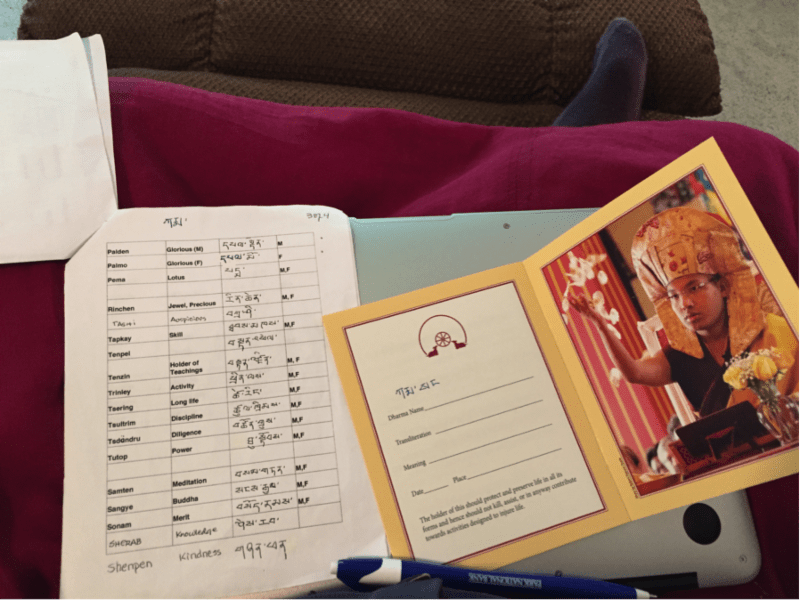
It’s one of the most enjoyable parts of my job: sitting in my easy chair, light coming through the front window, writing in ballpoint pen on little booklets the names for an upcoming Refuge Vow Ceremony.

The curls and squiggles of Tibetan script still challenge me; I’m sure I write with the same American accent I use when I try to say a few words of my adopted liturgical language. There’s a secret fear in the bottom of my stomach, that a Tibetan lama someday will see my scribbling and “tsk” and chuckle quietly to herself about my atrocious penmanship.

Folks ask how I choose Refuge Names – those combinations of words, preceded by the name “Karma” to indicate the recipients as part of the spiritual family of Karmapa – that are given out near the conclusion of a Refuge Vow-Taking Ceremony.

Great lamas can size up the spiritual qualities of disciples and name them perfectly on the spot; folks like me rely on the beauty of synchronicity, choosing names from a list and letting karma guide my hand in choosing the name as the candidate approaches my seat.

The ceremony of taking the Refuge Vow is 2,500 years old, and the lineage of the vow is unbroken since that time. Since the historical Buddha Shakyamuni began accepting those who wish to “take refuge” from the sufferings of samsara by placing their reliance on the Buddha as teacher, the dharma as path and the sangha as community, the vow has been handed down, generation after generation – across the lines of country, nation, gender, species, time and space.

Each generation has held the vow close to their hearts and then passed it along, in a living lineage that carries with it the same power and blessing as it did when the first Founder of our faith, the Buddha, gave it to his disciples.

So when we receive the Vow of Refuge, we receive a core of inner strength, a core of remembrance of our powerful, hidden, beginningless and endless Buddha nature, that can reassure us in difficult times and propel us down the path toward letting go of the causes of suffering and embracing the causes of happiness.

At the end of the road – the fulfillment of the goal set by the vow – is the complete liberation from suffering called Buddhahood, enlightenment, or awakening. The vow is the entry to that path, a beginning without an end, a mystery of intention that crosses lifetimes and leads us to benefit others endlessly.

All of that is contained in these little names, these “Tenzins” and “Sangyes” and “Lhamos” (“Holders of the Teachings,” “Awakened One,” and “Goddess”) and dozens more like them. The names are a shorthand for what has always been within us, the Buddha Nature, the mind that has the potential to see its own inner nature and awaken to perfect wisdom and joy.

And the hope is that those receiving those names will take the inspiration held within them and ride it like a breath of fresh wind, moving ever closer to ultimate peace.

So, even though I chuckle to myself sometimes, and fear that I’m jumbling the names rather than making them clear, I know that at some level they will take hold of the people who receive them, and those names will travel with them into the future – when they will use them to the ultimate benefit of all.


The Journey Home

This week’s episode of The Journey Home: Columbus KTC Rebuilds Its Temple, involves lights, cameras, and action at the home of KTC Member at Large, Eric Weinberg.

In the coming months, Eric and the other members of our hard-working Columbus KTC Board – Director Kim Miracle, Assistant Director Michelle Evans, Treasurer Steve Phallen, Secretary Justin Fitch – will be unveiling a new Rebuilding Campaign goal and the latest copies of the plans for our new building.

Those drawings you see on display in the basement of Congregation Tifereth Israel are the “first drafts” of our new temple; Columbus-based architects Peter Lenz and Pete Macrae are working on “KTC Rebuilding 2.0” and will have something for us to see in a couple of months.

Until then, it’s all fundraising, all the time. Our first online auction netted $13,000 in donations, and recently, we had fundraisers with martial arts luminary Stephen K. Hayes and a booth at the 10th Annual Independents’ Day arts festival on Washington Boulevard in Franklinton.

Along with that, we’re working on a short film (just a few minutes long) that will introduce the project to a wider general audience. And for that, you need someone with a camera, lights, and experience.

As luck would have it, Ryan Sweeney, Eric Weinberg’s neighbor, has all of these, and this past week a group of us met to be interviewed on camera for the film.

You won’t see the results until late October, but we’re confident that it will help you and your friends learn more about KTC and what we do to make Columbus a great and mindful place.

May all beings benefit!

Columbus KTC on the Move: September 18th – October 2nd

Greetings Sangha Members,

On Sundays September 24th and October 1st, Columbus KTC will be holding its Sunday services at the Martin de Porres Center at Ohio Dominican University while congregants of Tifereth Israel celebrate their high holy days at Tifereth.

Tuesday night Chenrezig practices will also be relocating during this time. They will be held at the Center for Pragmatic Buddhism in Grandview on Tuesdays September 19th and 26th.

No Columbus KTC programs will be held at Tifereth Israel Congregation through the conclusion of programs Sunday, September 17th up until our return Tuesday, October 3rd, for Chenrezig, and Sunday, October 8th, for Sunday programs.

Volunteers!

To make this move happen, we need volunteers to help pack up, move, unpack, set-up, then repack and return Columbus KTC’s items during the following times and dates:

  • Sunday, September 17th, Tifereth, following the Dharma Talk (pack up)
  • Sunday, September 24th, Martin de Porres, 8am (set-up)
  • Sunday, October 1st, Martin de Porres, following Dharma Talk (pack up)

If you can volunteer, please show up at these times. Thank you!

Lama Kathy’s Dharma Blog: Seeing Ourselves in Others Touched by Tragedy

With the tragic news this week of devastating floods in east Texas, lots of folks are asking what they can do to be of help. The sight of thousands of people displaced and trying to escape the floodwaters is distressing and painful, and our natural compassion leaps up and wants to help.

Excellent efforts by the Red Cross and other governmental and non-governmental agencies are drawing material support from all over the country.

Even a small amount of money can help people suffering from homelessness and the trauma of being separated from everything they know. Refugees don’t just come from foreign countries; they come from anywhere outside our normal, comfortable sphere. Their pain is our pain, and by helping them, we help ourselves.

We’ve all experienced loss; we all know what it’s like to lose the people and things we love. In that moment of empathy, we can forget all conflict, anger and disputation, and connect genuinely in ways that really matter.

So, in tragedy, look to the heroes – all the people who run toward danger to save the lives of others; all the people who see themselves in others and let go of prejudice and fear to fully embrace that human connection.

We’re seeing it in Texas – Muslim youths banding together to rescue the stranded, people of all colors and faiths reaching across lines to scoop up those in danger and bring them to safety.

Say prayers for the safety of all those – the stranded and the rescuers – and also rejoice in the purity of their action. Make the aspiration that you, too, will be able to reach out the day a person comes to you for help.

So many people come to us each day, and there’s no way we have the energy and resources to help them all. But when we can stretch, even just a little bit, beyond our narrow view, a flood of goodness may pour into our hearts.

Stay strong, Texas; help is on the way.

Note: Good prayers to say in the face of any difficulty are the Mantra of the Compassionate Bodhisattva Chenrezig (OM MANI PEME HUNG) and the Tashi Prayer, which can be found here:
http://www.lamakathy.net/resources/pdf/tashi_prayer.pdf

And here’s a short list of ways to assist those affected by the flooding in Texas: https://www.cbsnews.com/news/houston-flooding-hurricane-harvey-recovery-how-to-help-donate/

Fall Retreat: Time to “Get Away” with Your Practice

As summer draws to a close, we prepare for our annual Fall Retreat at Glen Helen Nature Preserve. It’s a yearly chance to “get away from it all” and spend time together in the company of dharma folk. We take walks in the woods and follow a monastic schedule – similar to the schedule of our “home” center, Karma Triyana Dharmachakra Monastery in Woodstock, NY – so we can slow down and give our minds a chance to relax and absorb the meaning of our dharma practice.

Here’s a little description of the program; check your calendar and reserve your space in advance!

KTC 2017 Fall Retreat: Bringing Compassion to Life

We may wish to become more compassionate people, but today’s world, with all of its strife, makes compassion feel like a very distant goal. But a short daily practice developed in 12th Century Tibet can bring compassion to your everyday life and change your experience of the world. During the teaching sessions of this weekend retreat in the woods near Yellow Springs, Lama Kathy will teach the short daily compassion training practice and how this practice can be used when anger, fear, impatience and other mental afflictions arise. Participants will take home a training program (including the traditional Lojong Mind-Training Slogans) that they can use in their everyday lives to increase their loving and compassionate response.